
How have non-fiction books changed? Jules Pottle, Primary science specialist teacher, trainer and author at DK, explains how the gap between non-fiction and fiction is narrowing and why this is helping students to engage with the subject matter more deeply
The shelves in a bookshop used to be clearly different. In the seventies, fiction books had colourful covers, suggesting magic and adventure. The paper was cream-coloured and uncoated, and rarely had any artwork besides the cover, or maybe a map. Really expensive fiction books had an odd colourful insert with a few illustrations that weren’t necessarily positioned next to the text they illustrated. In contrast, non-fiction books looked more serious, printed on shiny paper in columns with black-and-white photos of interesting things.
Fast-forward to the nineties, and there is a riot of colour. The non-fiction books are full of colour photos, and many of the shorter novels have colour illustrations on every page. Even textbooks are brightly coloured and full of jolly cartoon images.
More recently, you can see yet more diversification in non-fiction once again. A few non-fiction books are gently creeping in the direction of the storybook: the pages might not be so shiny, the colours might not be so bright. Photographs are replaced by stylised artwork, and the words are starting to sound more emotive, more like a story.

Why are stories useful when we are dealing with facts? Why not stick to explanatory text? To answer this, I shall refer to the mountain of research that has been done on the way that we process stories.
Our brains engage more deeply and are less easily distracted from information in the form of a story. The psychologist Gordon H. Bower calls this psychological privilege (Bower, 1978). Our brains treat stories differently from other kinds of writing. We look for causality – one thing being linked to another – a cause and effect. We look for characters, which are neither wholly good nor bad, conflicts between those characters, and satisfying twists in the tale – complications. Bower calls these the 4 Cs.
There is further research showing that engaging our emotions heightens all kinds of skills important for learning (Tyng et al., 2017):
- Perception
- Attention
- Learning
- Memory
- Reasoning
- Problem-solving
With all the added advantages of the story format, it is not surprising that there are more books of this type on the market. Teachers find them easy to share in the classroom and children engage well with them.
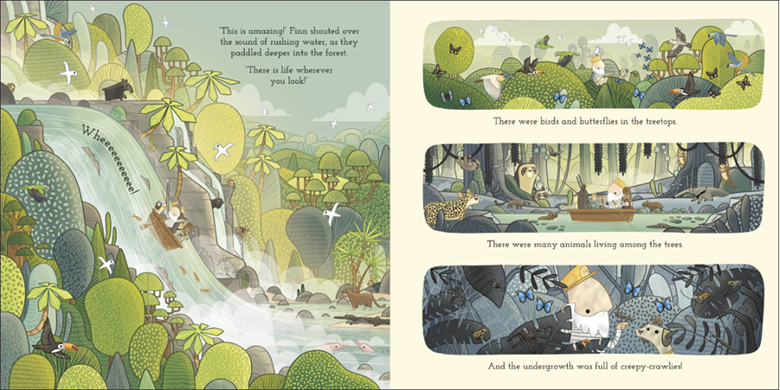
At the same time, authors such as myself are developing stories that are entirely fictional and yet explain something factual. We are creeping in the opposite direction, from stories towards non-fiction, so that we can fully employ the power of stories in engaging children in learning.
My first picture book The Molliebird was tested in schools for its effectiveness as a teaching text. The storyline tackled the topic of ‘Natural Selection’ through the fictional tale of a blue bird in a forest. Classroom research of The Molliebirdand my later book about the difference between spiders and insects (Jasper the Spider), showed that children engaged really well with this style of fictional science story that also promoted the use of relevant scientific language in the classroom. DK has a number of books that are a mixture of a story format and explanatory language. These have a fictional storyline, but the characters use science to solve the problem. This science is often quite high level and needs some explanatory language – so the science is presented in conversation, with one character explaining it to another, or in an information box inserted into the page of text.
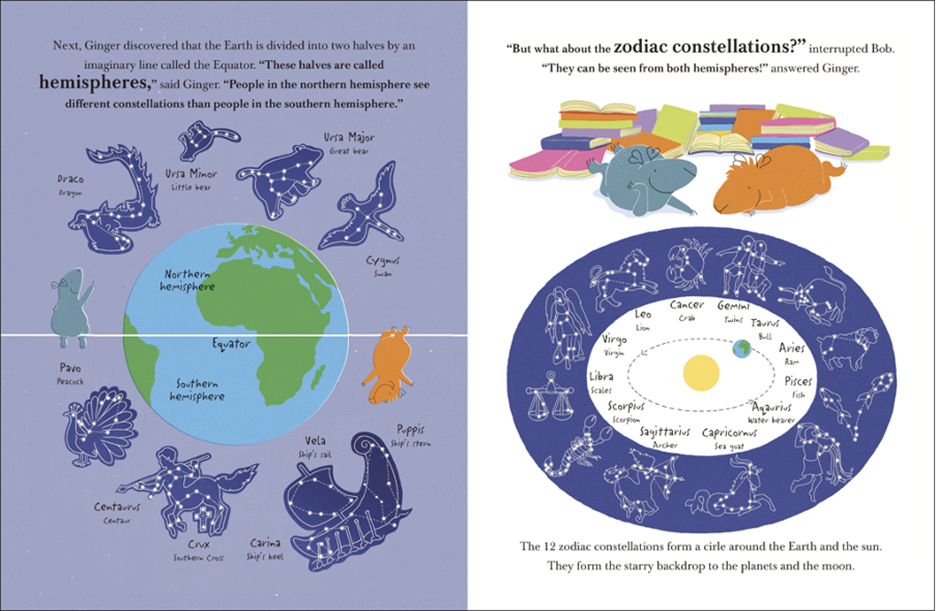
I have encountered many people, particularly in secondary-level science, who don’t see a need for the subject to be ‘dressed up’ as a story in any of these formats. For them, science is a wonderfully engaging topic that needs no embellishment. They worry about children being unable to tell which parts of the book are real and which are not. However, different children respond positively to different texts, and it is my opinion that anything that helps children to engage in science – and see that science is relevant and interesting – is a good thing. I also think that, as long as a science story is set in a world that obeys the same rules as the natural world, it is unlikely to cause an issue.
The lines between the two genres, fiction and non-fiction, are becoming increasingly blurred, and the breadth of choice available to young learners is increasing. This can only be a positive thing. Some children will always choose a more traditional non-fiction style book, which offers the option of dipping in and out of pages that look interesting. They love the pictures and the clear explanations of the facts. Others will tend to choose a story to dive into, and remain submerged in it until the final page. They enjoy being engaged emotionally in the book.
All types of books can provide the doorway to learning, and I, for one, welcome the variety on my classroom bookshelves. As long as the science is accurate, the books are likely to educate, and I welcome them all.
- - - - - - - -
Would you like to share a comment? Register for your free ISN profile and add a response below!
- - - - - - - -
** Publish with ISN ** To share your ideas with the ISN Community, please send your article directly to our editorial team here, or email us at [email protected]