


In collaboration with 'Making Stuff Better', Ann Lautrette, Deputy Head of Secondary at Taipei European School in Taiwan shares her passion for the natural world and draws correlations between a thriving ecosystem, and producing a vibrant and harmonious school community.
Fifteen years ago I learned to Scuba Dive. At the time, I was living in Jeddah, Saudi Arabia, and it seemed a shame to miss out on the sheer beauty of the underwater world of the Red Sea. Since then, living in Indonesia and Taiwan, I’ve been lucky enough to dive in some of the only places left on earth where coral reefs are still thriving. Observing living coral, communities of fish and invertebrate creatures co-existing in harmony is a humbling experience for a diver accustomed to the hierarchical structures of life on terra firma. On a reef, each organism contributes to the health and vitality of the ecosystem, relationships are symbiotic and no one species dominates and controls.
It’s reminiscent of what schools could be.
Like reef protection, we need to protect learning and professional growth in our schools if we want our organisations to thrive.
Whitney Johnson in ‘Your Organization Needs a Learning Ecosystem’ writes that’ “like a biological ecosystem, organizations are either growing or they’re dying. And organizations grow when their employees are learning. A lively ecosystem — where different parts interact with one another — helps people grow, generates capacity, and keeps the ecosystem flourishing.” (Johnson 2019) Sadly, as a diver, I’ve seen what happens when we don’t nourish our ecosystems. Once, in the Gili Islands off the coast of Bali, I descended at ‘Shark Point’, where the thrill of seeing black and white-tipped reef sharks was tempered by dismay at the white-bleached and broken coral; the result of years of dynamite fishing. Like reef protection, we need to protect learning and professional growth in our schools if we want our organisations to thrive.
By definition, schools should be ‘learning organisations’ (Johnson 2019). Peter Senge, in his book The Fifth Discipline, defined a learning organization as one "in which you cannot not learn because learning is so insinuated into the fabric of life." (Senge 1990) Since the raison d’etre or the ‘fabric of life’ of a school is learning then it seems that if we want our schools to grow, we need to treat them as coral reefs: where every member of the school community is valued equally for their contribution to our shared mission and vision. Xiaoliuqiu or ‘Little Okinawa’ Island lies only 10 miles off the west coast of Taiwan. It’s famous for being home to more than 800 green sea turtles that you can see in the water just by donning a pair of swimming goggles. The turtles are protected by strict national park laws (as one You-Tuber found out when he filmed himself touching one and was slapped with a fine of 10,000 US dollars). Taiwan has made a huge investment in time, money and education to protect its turtles because turtles maintain the balance of underwater ecosystems by grazing on seagrasses and algae. An abundance of sea turtles also indicates the overall good health of the marine world around Taiwan. To draw a parallel to schools; to have a healthy school, we must invest time and resources in the learning of each and every member: students, naturally, but also teachers, support staff, administrators and parents. A happy, thriving community is a measure of the success of that investment.
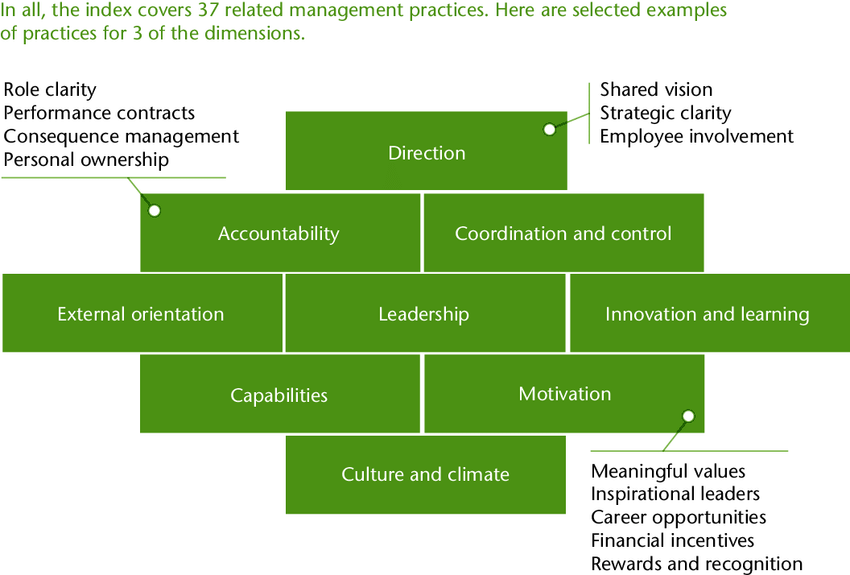
In ‘Beyond Performance: How Great Organisations Build Competitive Advantage’, Keller and Price (2011) identify nine measures of organisational health, which Bazigos helpfully structures in a diagram (2016):
A vibrant culture of coaching creates a mindset of inter-dependency, continuous learning and collaboration.
Like a natural ecosystem, these measures of health are interrelated and co-dependent. Without a direction, there can be no relevant innovation and learning, without a positive culture and climate, there will be little motivation. Just as damage to the underwater ecosystem results ultimately in the death of coral reefs, a school cannot function optimally when its leadership is damaged by approaches that don’t inspire its community, or practices for accountability which create a culture of fear rather than continuous growth. Everyone in a school needs to understand what is expected of them, and have agency to take opportunities when they arise. Continued learning and professional growth result in the capabilities of teachers to effect learning and to engage with external stakeholders such as parents and the wider community. When teachers feel a vital part of a learning ecosystem they have the motivation to keep learning to innovate in their practice.
Just as corals in a reef provide a foundation for the growth of other organisms, a healthy school community needs to be founded on support for one another. A vibrant culture of coaching creates a mindset of inter-dependency, continuous learning and collaboration.
Steve Barkley in ‘Quality Teaching in a Culture of Coaching’ (2010) describes how establishing a culture of coaching results in ‘a synergy of creativity’. When teachers, and the rest of the community, support and are supported, ‘students receive the benefit of an improved teacher in their classrooms; administrators receive the respect and support from an admiring and productive staff. All receive the caring and support for each other.’ (Barkley, 2010)
If we don’t take action to preserve the health of our schools, teacher shortages, unequal access to resources and the wellbeing challenges facing our students and teachers threaten to destabilise our communities.
In my practice as a leader, creating a coaching culture has been fundamental to the health of the schools I have worked in. Giving teachers the opportunity to work in pairs and triads when setting areas of focus for evolving their practice, observing each other as ‘critical friends’ rather than evaluators, and working together to develop professionally have all contributed to a dynamic ecosystem, with the kind of inter-connectedness we see in our planet’s natural systems.
Like a coral reef, a school only exists because of the symbiotic relationship natural to education. Teachers and students do not learn in isolation in schools. Knowledge building, hypothesising, testing and reflecting are constructed cooperatively and therefore, in schools, we must prioritise and protect healthy relationships if we want everyone in our community to feel a deep sense of belonging, to experience organic growth and to thrive as learners and humans.
As leaders, we must facilitate the conditions for symbiosis by offering trust in the professionalism and commitment of our teachers, encouraging innovation by modelling failure and reflection and committing to ‘humble leadership’ by understanding that we are no greater a part of the ecosystem than any other member. We must also protect our own wellbeing, because, like the green sea turtles, our health is a measure of the health of our environment.
Sadly, the human impact on our planet in the form of climate change, unsustainable fishing and pollution is causing irreperable damage to the fragile ecosystems of our coral reefs. If we don’t take action to preserve the health of our schools, teacher shortages, unequal access to resources and the wellbeing challenges facing our students and teachers threaten to destabilise our communities and break the bonds that hold our societies together.
In our post-covid era, we must work together to rebuild the trust we need to have in each other in order to redevelop our sense of community and purpose. We can start by learning a lesson from our natural world: A culture of inter-dependence, coaching and continuous evolution results in a strong and healthy ecosystem, whether that be an awe-inspiring coral reef, or a vibrant and diverse school.
References
Barkley, Stephen G. 2010. Quality Teaching in a Culture of Coaching. N.p.: Rowman & Littlefield Education.
Bazigos, Michael. 2016. “Leading for Long-Term Performance: Matching the Behavior to the Situation.” Journal of Leadership Studies. 10, no. 2 (08): 44-51. 10.1002/jls.21472.
Johnson, Whitney. 2019. “Your Organization Needs a Learning Ecosystem.” Harvard Business Review. https://hbr.org/2019/07/your-organization-needs-a-learning-ecosystem.
Keller, Scott, and Colin Price. 2011. Beyond Performance: How Great Organizations Build Ultimate Competitive Advantage. New Jersey: Wiley.
Senge, Peter M. 1990. The Fifth Discipline. N.p.: Doubleday Business.
- - - - - - - -
** Not registered yet? Create your free profile here and add a response below **
To share your story, thoughts or ideas with the ISN community, please send your article draft directly to our editorial team here, or email us at [email protected]