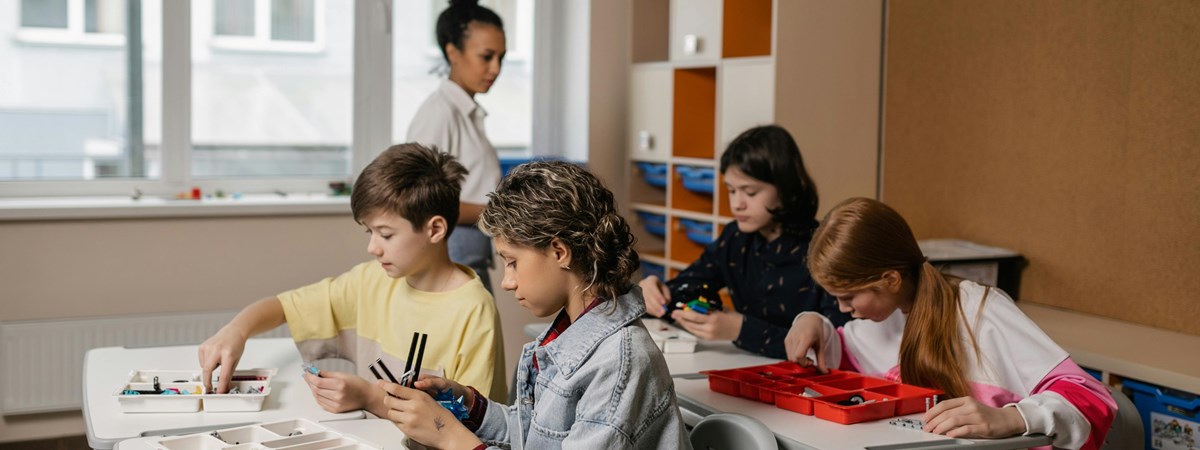

Whitney Edmundson, Learning and Teaching Lead for Curriculum Maths at Raha International School, explores 5 ways to develop authentic assessment to support all students.
We all remember the tests we did in school. The worry that this one test will decide our entire future and limit our opportunities. This feeling is the reason that authentic assessment is so valuable. It stops students feeling as though they have limited control of their learning and future.
I write this article as a student of mine recently received her grade back and one test result seemed like the end of the world. After discussing the success of her project work she started to be more positive and see how this is a large proportion of her overall grade. And so began a valuable reflection discussing all of her assessments, not just the one "bad" grade (for the record it was not as bad as she was seeing it). I was so grateful for the authentic assessments we have created that gave her a place to celebrate success and determine her own future and feelings about her skills in Mathematics.
The reality is that all curriculums have tests/assessments/exams but we can also prepare them in others ways to ensure they go out into the world and have the most real life connections and experiences in Maths. I have read about the reasons why do students lose their love for Maths as they get older and I believe assessment styles and school pressures play a huge role in this. Today I want to focus on the assessments.
So, here are 5 ways I believe you can design authentic assessment without spending weeks rewriting your curriculum.
1. Make it practical
'...where was the inquiry and memorability?'
When I first began teaching IB I would see these assessments that talked about probability and counters in a bag. It went on to discuss with replacement and without replacement and my students were just drawing the situation but not seeing the concept. For the most part they could draw it but where was the inquiry and memorability?
Get a bag of counters!
Give students less structure and more space to inquire. You could give your students a bag each containing different coloured counters and you can even differentiate them for the students. Give them a prompt that guides but let them investigate and see where it takes them. Having them see the problem changes everything!
2. Allow the time
"The value of inquiry over traditional teaching is incredible"
I know this one is easier to say than do sometimes but are you really wasting time if it takes a bit longer than you planned? The value of inquiry over traditional teaching is incredible. All we want is understanding, application and retention. I believe it is so much harded to gain retention if you teach without inquiry. Discuss with your team, plan the time in around the curriculum or even work with another subject and run an interdisciplinary unit. If you are really short on time you can create activities for form/mentor time and then get the time back in the classroom. There are so many ways you can play around with your timeline to allow inquiry but it does sometimes take a risk taker to get it done!
Be that risktaker!
3. Provide choice and flexibility

Sometimes the connection to real life is just having the students connect it to their life. Allowing choice and flexibility in an assessment can help students make the connections and in turn creates a more authentic assessment for them. Remember we are teachers and we most certainly are not the same age! So what might see as authentic and real life potentially is not for them. This can be through a style of submission or assessment that you design.
Maybe chat to the kids to get their imput?
I have an example of last year where we did linear graphs and created this huge discussion on taxis. "You know when the taxi has the meter at the front and it has a starting cost"... Yet half my class had never been in a taxi. So now I was asking them to write an assessment on something they have never experienced and would find it hard to connect to their real life. Its all about reflection and this year the unit was on business and shipping costs and it turns out my students get very into making money!
4. Provide ongoing feedback and reflection
The best assessments I have ran this year have been easy to grade. This is down to already providing the students with feedback and rubric reflection throughout the project. I can open up the grading and know where they were the last time I saw the work and I am now looking for improvement (which actually makes us better educators as we know the projects inside out).
For the students we talk about reflection so much in the MYP however, how much do we model and give them the time to do this?
I know you are thinking about time (every teachers key word) but this does not always have to be your feedback. Recently my grade 6 students were doing their first project and it involved Criteria C (communication) and Criteria D (real life applications). First I got them to go through their own project with a printed rubric and highlight what they could see. Then they had to justify to their partner where this was shown. If the partner agreed then fine, if not then they needed to take some time and make it clear. I say "if your friend doesn't understand it with the rubric then how can I as a teacher?"
Get the students to do the feedback. We have recently decided to use Microsoft forms more due to its tool of red and green answer reflection. We know often they look at their scores and walk out of the room forgetting what needs to be worked on. So with this, the students upload screenshots of their reflection with a typed positive and areas of improvement. They then come up with their own plan to work on the topics and maybe discuss this plan with a partner. All you have to do as an educator is look through and ensure they have completed a suitable reflection, adding comments if you wish.
Oh guess what, the parents see it too!
5. Utilising technology
"Sometimes it can be as simple as letting them show you what they can do".
I have a wonderful example of a student who got deep in a project and I remember his Mum telling me that for the first time ever he came home and said "I have to work on my Maths". Why was he consumed? Because he asked to design his city in VR and we said "sure, why not!". Sometimes it can be as simple as letting them show you what they can do. Don't be afraid to let them complete it in a way that is unknown to you, they might just surprise you and give an idea for the whole school!
Software and online tools can be a game changer for students with authentic assessment. How many times have you seen a student struggle to draw a linear graph yet they can discuss linear relationships with you in depth? Make it accessible to all and in-turn you might just eliminate the "when will I use this?" question that every maths teacher gets!
Take the risk and reflect on how it goes, who knows, you might find it easier to get the students engaged!
- - - - - - - -
** Not registered yet? Create your free profile here and add a response below **
To share your story, thoughts or ideas with the ISN community, please send your article draft directly to our editorial team here, or email us at [email protected]