

In this article, Dr. Donna Velliaris explores a common classroom predicament: how to maintain equity in group tasks.
The distinction between collaboration and collusion presents a formidable challenge within educational environments, frequently leading to confusion and uncertainty among students. It is imperative to establish a precise demarcation between these concepts. While fostering collaborative efforts is essential, presenting jointly completed work as individual endeavors, whether intentional or inadvertent, constitutes collusion and may result in academic misconduct.
This risk is particularly pronounced when group work extends beyond the classroom or when group members are assessed uniformly irrespective of individual contributions. Adherence to academic integrity standards not only permits but also encourages collaborative learning and peer tutoring, provided students adhere rigorously to relevant institutional policies and procedures.
Defining Collaboration and Collusion
Collaboration, synonymous with ‘group work’ in educational contexts, embodies a pedagogical approach where students engage collectively under instructor consent. It entails cooperative efforts aimed at exchanging ideas, integrating diverse perspectives, and collaboratively addressing complex assignments. Educators assign group tasks to foster cognitive depth and interpersonal skills among participants. Within collaborative settings, students function as co-learners, collectively pursuing shared academic goals while equitably distributing workload responsibilities.
Conversely, collusion starkly contrasts with collaboration in educational frameworks. Collusion signifies a deliberate departure from academic integrity, typically manifesting in scenarios involving assessments designed for individual evaluation. It encompasses illicit collaboration strategies where students collaborate deceptively to misrepresent individual efforts, such as sharing answers or jointly presenting work as indicative of individual proficiency.
Legitimate collaboration spans a spectrum of sanctioned activities, encompassing informal study groups, deliberations on assessment criteria, and initiatives for peer-supported skill enhancement. These endeavors enrich educational experiences by promoting transparent interactions and fostering collective learning outcomes. However, the merits of collaboration must be tempered with vigilance against inadvertent collusion, which may arise from ambiguous task delineations or inadequately defined expectations.
Clear documentation of institutional policies on collaborative practices is imperative to establish permissible boundaries and mitigate risks associated with academic misconduct. Educators play a pivotal role in articulating these guidelines, underscoring the significance of individual accountability and ethical conduct within collaborative settings. By cultivating an environment that upholds academic standards and integrity, educational institutions ensure equitable assessment practices and cultivate a culture of academic honesty among students.
Promoting Ethical Engagement
The distinction between collaboration and collusion in educational settings is pivotal for safeguarding integrity, fairness, and educational excellence. Ambiguity and misconceptions among students regarding these concepts necessitate clear establishment of boundaries and guidelines by educators. Central to this issue is the paramount importance of academic integrity. Collaborative efforts are advocated as they facilitate the exchange of ideas, exposure to diverse perspectives, and the development of essential teamwork skills. However, presenting jointly completed work as individual efforts, whether intentional or inadvertent, undermines the integrity of the academic process. Educators must unequivocally convey that such actions constitute collusion and may prompt academic misconduct proceedings.
Aspect Comparison: Collaboration vs. Collusion
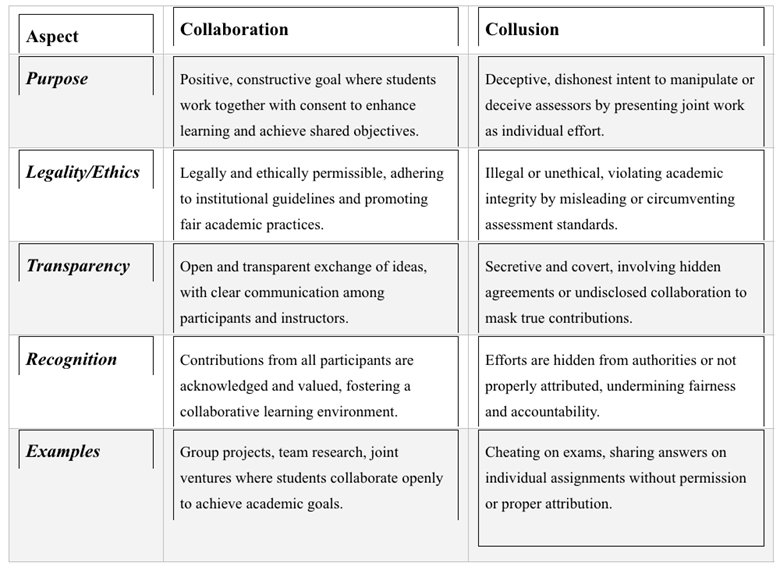
One significant risk factor arises when group work occurs outside the classroom or when uniform marks are assigned to group members regardless of individual contributions. In such scenarios, students may be tempted to engage in collusion to reduce workload or ensure favorable outcomes without requisite effort. Adherence to academic integrity standards is indispensable to prevent misconduct and uphold collaborative learning as an enriching experience for all participants. Moreover, distinguishing between collaboration and collusion fundamentally influences assignment structuring, assessment methodologies, and ultimately, learning outcomes.
Collaborative endeavors should be designed to foster deeper information processing, meaningful connections among participants, and equitable workload distribution. Students should be encouraged to function as co-learners, collectively striving toward common goals while respecting individual contributions. Navigating this balance between collaboration and individual accountability poses challenges. Educators must cultivate an environment that encourages constructive discourse while deterring inadvertent collusion. This necessitates clear communication of expectations, explicit documentation of course guidelines pertaining to collaboration, and sustained support and guidance from instructors. Furthermore, promoting an overt distinction between collaboration and collusion involves heightening awareness of academic integrity principles among students.
Summary
Cultivating positive staff-student relationships grounded in exemplary conduct and strategic planning is pivotal. Teachers should actively foster these relationships by implementing cooperative learning methodologies, continually enhancing assessment quality, and providing ongoing support and guidance to students. Fundamentally, delineating between collaboration and collusion is essential for preserving equity, fairness, and explicit standards within educational settings. By establishing clear boundaries, promoting academic integrity, and fostering a culture of responsible collaboration, educators ensure that students engage in collaborative learning experiences that are enriching and ethically commendable.
- - - - - - - -
** Not registered yet? Create your free profile here and add a response below **
To share your story, thoughts or ideas with the ISN community, please send your article draft directly to our editorial team here, or email us at [email protected]