

NACE introduces the Making Space for Able Learners project, exploring the importance of cognitive challenge and the effect this can have on learners’ knowledge attainment.
For NACE - National Association for Able Children in Education
“The research has shown that there are a significant number of strategies in place which promote excellent learning for more able pupils. Where the strategies are most successful, they are positioned in an environment where the vision and practice are understood and applied consistently across the organisation.”
- Cognitive challenge: principles into practice, National Association for Able Children in Education (NACE), 2020
When seeking a foundation of evidence and research on which to build effective provision for the most able learners, today’s education leaders and practitioners will often search in vain; the contemporary evidence base in this area is thin and not readily available.
Those coming from disadvantaged backgrounds or facing other barriers to achievement are at risk of going unnoticed and failing to receive the support they need and deserve.
This paucity of research is compounded by the fact that highly able learners are often overlooked and underserved. In particular, those coming from disadvantaged backgrounds or facing other barriers to achievement are at risk of going unnoticed and failing to receive the support they need and deserve. An additional imperative comes from the fact that focusing on improving provision and pedagogy for the most able is likely to have a positive impact on the learning experience of all pupils. In this context, NACE (the National Association for Able Children in Education) launched the Making Space for Able Learners project – seeking to review, collate, extend and disseminate evidence-based practice in this field. The first phase of the project focuses on approaches to developing “cognitive challenge”, with key findings summarised in the recent publication Cognitive challenge: principles into practice.
Based in the UK, NACE is an independent charity established almost 40 years ago, dedicated to supporting schools to improve provision for more able learners. We believe this project is an important step towards closing the existing evidence gap in policy and practice for the more able. It draws on a broad review of relevant research and theory – from both within and beyond education – and brings the theory to life through current examples from schools holding the NACE Challenge Award, an accreditation granted to recognise excellent provision for the more able within a context of challenge for all.
What is cognitive challenge and why does it matter?
Cognitive challenge prompts and stimulates extended and strategic thinking, as well as analytical and evaluative processes.
Cognitive challenge can be summarised as an approach to curriculum and pedagogy which focuses on optimising the engagement, learning and achievement of highly able children. NACE uses this term to describe how learners become able to understand and form complex and abstract ideas and solve problems. Cognitive challenge prompts and stimulates extended and strategic thinking, as well as analytical and evaluative processes. The traditional interpretation of challenge – using closed, standalone challenge/extension activities – can successfully increase pupils’ repertoire and skills, extending learning at specific times on specific topics. This has useful but limited benefits. Focusing on this limited approach can lead to learners becoming disengaged and can mean opportunities to develop cognitively challenging learning are missed.
Developing cognitive challenge in a way that is strategic, embedded and consistent can provide greater long-term learning gains, changing the way pupils think and increasing their capacity for flexible thought and imagination. It can improve pupils’ learning expertise, appetite for learning and wellbeing.
What does this look like in practice?
The principles of cognitive challenge are seen in practice across NACE’s community of member schools, across all sectors, phases and contexts, in England, Wales and internationally. This diverse network is united by a shared commitment to NACE’s core principles – including the belief that the education of more able learners is a whole-school endeavour to be embraced by all school leaders; that addressing the needs of more able learners will raise achievement for a much wider group of learners in a school; and that providing for more able learners is not about labelling, but about creating a curriculum and learning opportunities which allow all children to flourish.
The research project brings the theory to life through examples drawn from schools accredited with the NACE Challenge Award.
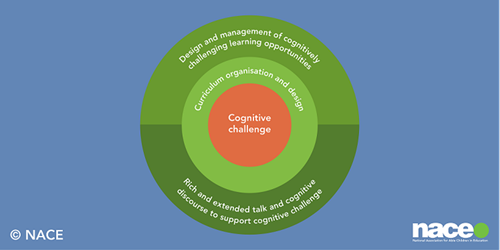
It focuses on the following three areas, identified as key areas through which cognitive challenge is made visible:
- Design and management of cognitively challenging learning opportunities;
- Rich and extended talk and cognitive discourse to support cognitive challenge;
- Curriculum organisation and design.
The importance of a whole-school approach
A common strand throughout the report – as highlighted in the quotation at the start of this article – is the importance of a whole-school approach: a clear and ambitious vision that is shared and implemented consistently across the school; a culture which promotes and sustains high-quality practice; strong leadership at all levels; and investment in professional development to support staff in delivering this.
This whole-school approach is central to NACE’s ethos, and to the NACE Challenge Development Programme, on which the Challenge Award is based. The Programme is founded on the NACE Challenge Framework, which provides a robust and comprehensive framework for school self-evaluation and whole-school improvement, centred on curriculum and classroom challenge, and designed to support consistency of approach involving the whole school community – learners, teachers, parents, partners, governors and school leaders.
While detailed and rigorous, the Framework is not tied to a particular pedagogy or curriculum, meaning it can be used by all types of school, across all key stages and subjects, and in all locations and contexts. Indeed, one of the most powerful aspects of the Framework is that it provides scope for schools to create new and innovative approaches and strategies to enhance their provision. This is reflected in the NACE report, which showcases the broad range of strategies that can be used to promote cognitive challenge, once the underlying leadership, ethos and principles are established.
Find out more:
- Cognitive challenge: principles into practice – preview the report and order a copy; an on-demand CPD session is also available to support whole-school training.
- NACE international membership – join NACE’s global community of school leaders and practitioners who are uncompromising in their ambition to ensure learners reach their potential.