

Experienced senior leader, Ben Dolbear, reflects on the UK curriculum model and explores the merits of lifelong learning.
Picture a classroom in a typical school. Now think what a classroom would have looked like 20 years ago. What about 50? 100?! A typical classroom hasn't really changed a great deal – ever. And yet, everything else has. Within a school, think of how we take the register, how some of us may mark work (online). Beyond the gates, how we communicate, how the mobile phone has developed since its inception. This idea was presented at a conference I attended a few years ago, with the added use of a photograph of a nineteenth century classroom and another of a modern day one. The presenter was trying to convey how education needs to change and adapt in line with the ever-evolving world that we live in. Beyond the aesthetics, this would, of course, includes the curriculum and assessment.
A brief analysis of the current situation
"How many times has a student asked you ‘is this going to be in the exam?’ and then lose interest in what you’re saying when you say ‘well, no, but...’ (sigh)."
The national curriculum and the UK model of education is a huge part of this inability to move forward. The relentless learn – revise – test – move on cycle at the centre of the system decimates the thirst for lifelong learning as learning is seen as a chore and something that you do to move on to the next step in life. We’re obsessed with summative assessments across specific subject areas so that we can categorise people by letters and numbers. There is a place for assessment, but is the UK approach sucking the enjoyment out of learning? How many times has a student asked you ‘is this going to be in the exam?’ and then lose interest in what you’re saying when you say ‘well, no, but...’ (sigh).
Education by subject with a focus on exams has been indoctrinated into British society – not just the education system. It’s actually really difficult to envisage an alternative system, because the current model has been the status quo for such a long time. And yet, something has to change. Simplistically, we can devise learning into knowledge and skills. The UK curriculum is based on subject knowledge, with skills a mere afterthought and only related to academic skills within the context of a given subject. This needs to flip the other way, with an emphasis on (ever-evolving) skills. How important is knowledge recall in today’s world?
Companies are putting in place their own skills-based training as part of school-leaver and graduate schemes because schools aren’t equipping young people with what is needed. This isn’t the fault of schools. This is a national policy issue. Schools can address this area themselves, but they are bound by the existing curriculum and assessment, and expectations of government.
Existing alternatives
There are alternative models of education. Most notably in an international context, the IB programmes, which are certainly more wholesome and rounded than the British system. Indeed, the Conservative government response to the problem in hand has been to develop a British Baccalaureate for post 16 students. Besides the fact that the British Baccalaureate proposal is lacking in any great detail and likely to remain a more academic pathway, we also need reform much earlier in the education journey. Do we need GCSEs at all given that young people should remain in some form of education until they are 18?
A different alternative?
Perhaps a more radical change is needed. An enthusiasm for lifelong learning needs to be at the centre of everything, since modern citizens will need to constantly change and update their knowledge and skills. Does the UK system support this? To facilitate a love of learning from a young age, and acceptance that constant learning and adaptation is essential is of the utmost importance.
Can you ‘teach’ lifelong learning? You can certainly enable students to develop their cognitive aptitude to believe in themselves and their ability to learn, how to learn, how to reflect and engage with feedback.
Thinking beyond the existing framework is difficult. It is often easier in the short term to keep doing the same thing. What might a new framework in schools look like? Accenture – a leading global consultancy firm – have developed a ‘New Skills Now curriculum’, based on extensive research, which is designed to ‘prepare learners for success in the digital economy’. Skills that are needed to ‘stay relevant and thrive’. The curriculum overview looks like this:
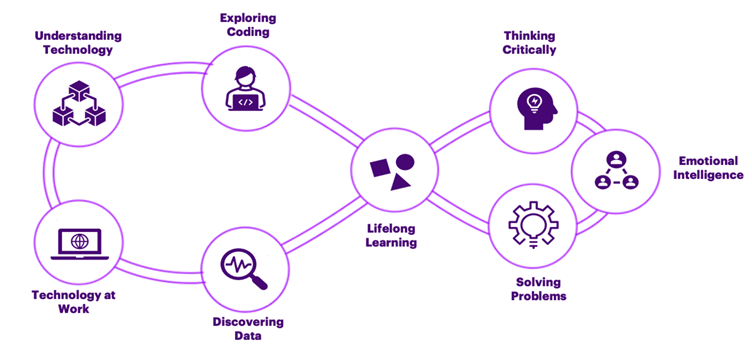
There are two broad skills sets here - technical skills on the left and soft skills on the right.
At the centre, linking the skill sub-sets, is lifelong learning. Clearly this is not a complete model to replace the curriculum, but it is an excellent starting point. Weaving these skills into the IB programmes could be done. The British Curriculum though, needs a complete reset, with these skills at the heart of the model. A great deal of work would be needed to integrate traditional subject disciplines appropriately, as well as further considerations of other skills required for life in the modern world. This ought to extend to values and principles, particularly with the rise of populism, division in society and the constant safeguarding curve balls that arise through technology. The Labour Party are proposing some reasonable reforms, for example ‘a broader and richer curriculum and a full review of how it’s assessed’ and 'ensuring all our children have the digital skills they need’. But their proposals are nowhere near as radical as required. A complete curriculum review and transformation is required. Will the government be bold enough to take this task on, or will it be left to schools to try and deliver the national curriculum as well as attempt to provide young people with the skills they need for the future? Some might say this is an impossible task.
Discover more about the Accenture curriculum here: https://s2sacademy.com/cms/uk/raising_awareness_files/New%20Skills%20Now%20Poster%20Leaflet.pdf
- - - - - - - -
** Not registered yet? Create your free profile here and add a response below **
To share your story, thoughts or ideas with the ISN community, please send your article draft directly to our editorial team here, or email us at [email protected]